What happened at Bar Boele lasted about thirty seconds. What followed lasted months.
In the days after the incident, it seemed as though the matter would blow over. Marlon and Reinout deliberately avoided the university to let things settle. The Christmas break was approaching. Marlon travelled to Rome on behalf of VSP for the Atreju conference. Life within VSP went on: there was a big Christmas gathering, a board dinner, and the party stayed active.
Everything suggested that the incident, unpleasant as it was, would ultimately remain what it was: a provoked bar-room scuffle after an evening full of provocation. Marlon and Reinout thought their opponents, once sober, would also have recognised that their own part in that evening was at least as significant. This could have been something ordinary people resolved the next day with a conversation, a handshake, and the shared conclusion that everyone should have acted better.
Or so it seemed.
Taken from his bed
On 30 December, everything changed.
In the early hours, Reinout was taken from his bed. Around 5:30am, officers stood at the door. He was arrested on suspicion of public violence and discrimination, handcuffed and taken away. He then had to wait about six hours before being questioned, and his phone was seized.
Marlon was fortunate to be abroad at the time. Because of that, he wasn't picked up at home, but was able to arrange by phone to report to the police station himself the next day.
The way they were treated bore no relation whatsoever to what had actually happened. As if they had prepared a terrorist attack. As if they were part of a serious criminal organisation. As if this were a major violence case, when in reality it was a provoked scuffle in a bar that ended in a bloody nose.
It didn't stop there. Reinout's phone was held for a long time. Marlon was subjected to a wiretap. His conversations were monitored as part of the investigation. Even the wiretap transcript ultimately showed nothing incriminating. Nothing at all.
That raises the question: why was such heavy action taken over a thirty-second scuffle?
The discrimination switch flipped
The answer lies in the frame that was built immediately after the incident. Because the student involved and his allies claimed there was discrimination, the case ended up in an entirely different category. Not as an ordinary bar incident, and not as a scuffle of a kind Amsterdam sees more serious examples of every day, but as a case with a possible discriminatory motive.
That meant the case wasn't treated as a simple violence matter, but placed on the discrimination pile.
That's essential to understanding what happened next. The case ended up with a prosecutor specialised in discrimination, hate speech and hate crimes, not just any prosecutor assessing a bar scuffle, but someone from the National Discrimination Expertise Centre. That meant the case was viewed, from the very start, through the lens of hate, racism and discrimination.
That's exactly what made it dangerous. Because once that lens was in place, everything was seen through that frame. A scuffle became a possible hate crime. Contradictory statements became evidence of discrimination. A political opponent became a defenceless victim. And Marlon and Reinout were cast as perpetrators of racist violence.
A new discrimination law
On 1 July 2025, a new law took effect establishing the discriminatory element as a general aggravating factor in sentencing. As a result, the maximum sentence can be increased by a third when a criminal offence is committed with a discriminatory element.
Bill: discriminatory element as an aggravating factor View the bill on eerstekamer.nl →That law originated from a bill sponsored by, among others, Frans Timmermans. In its explanatory notes and parliamentary handling, it was about genuine hate crimes: offences in which hatred toward or discrimination of a group of people was a driving motive. Think of antisemitic incidents, threats around mosques, and vandalism at Jewish institutions.
It's also important to note what doesn't automatically fall under it. Not every insult or crude remark made during an offence turns that offence into a discrimination case. A random robber who hurls racist abuse during a robbery doesn't automatically commit a hate crime by doing so. Choosing someone because they're physically more vulnerable doesn't automatically qualify either. The same goes for robbing someone at a gay meeting spot because the perpetrator thinks the victim is less likely to report it, or for targeting a child or elderly person because of their vulnerability.
There must therefore be a material link between the offence and the discriminatory element. It must involve an act in which hatred toward, or discrimination of, a group is expressed. That is something entirely different from a provoked bar-room scuffle after hours of verbal abuse, provocation and beer-throwing.
Yet this case was used for exactly that: as a showcase case. A case through which the new discrimination approach could be put on display. And what better way than with the chair of the largest right-wing student party in the Netherlands, and Reinout Vlaardingerbroek, the younger brother of Eva Vlaardingerbroek?
First relief, then disbelief
After the questioning and the investigation, Marlon and Reinout were shocked by the way they had been treated. The arrest, the seizure of phones, the wiretap, the tone of the investigation: everything felt as though they were being treated as dangerous extremists.
At the same time, they thought the matter was behind them. The camera footage would show what had really happened. The statements contradicted each other. There was no evidence of a racist motive. There was no serious assault. There was no hate crime.
So they trusted that the case would be dropped, or that they would ultimately be acquitted in court.
But there was no peace to be had.
8 January: the media strike
On 8 January, the first major articles appeared. Ad Valvas and Het Parool framed the incident exactly the way VSP's opponents had hoped.
For VSP's political opponents, this was the moment they smelled blood. What, on the night itself, had been nothing more than a provoked scuffle was seized on as a chance to finally achieve what three years hadn't managed: permanently damaging Marlon, Reinout and VSP. Not through debate, not through elections, not through substantive criticism, but through framing, anonymous statements, media pressure and criminal law. With the help of friendly and cooperative media contacts, the incident was blown up into the story they had wanted to tell for years: VSP as a danger, Marlon as the perpetrator, Reinout as an accomplice, and the activist opposition as the victims.
Ad Valvas published under the headline: "VSP members arrested for assaulting student." The article spoke of deportation, of the n-word, of hard blows, and of a victim who had supposedly been assaulted. The statements were anonymous, came from the same political circle, and contained exactly the elements needed to turn a bar scuffle into a hate crime.
Het Parool did the same. The headline and framing were devastating: a student gathering on the VU campus had supposedly escalated after a Nazi song, with a student allegedly seriously assaulted. The story was then picked up by other outlets, often without carefully presenting the other side.
The context from chapter one and chapter two was almost entirely absent. The years-long smear campaign against VSP went unexplained. The role of the student involved as an activist was left out of the picture. The political background of the witnesses wasn't mentioned. That Marlon was doused in beer first was misrepresented. That Marlon and Reinout had specifically tried to leave and prevent further escalation disappeared from view.
That's how the story that would keep circulating for months was born: Marlon and Reinout as perpetrators of far-right violence, the activist opposition as defenceless victims.
Trial by media, courtesy of Het Parool
Separate from the incident and separate from the criminal case, a second track emerged in the months in between: a trial by media conducted by Het Parool. That track was no longer about what exactly had happened that evening at Bar Boele, but about the attempt to publicly destroy Marlon as a person and VSP as a movement.
Tahrim Ramdjan of Het Parool played a central role in this. Tjarda Kuyt was also involved in the coverage, but Ramdjan was the one who actively kept digging. Marlon is, moreover, not the only one with serious criticism of his methods. In other matters, too, Ramdjan has been sharply challenged on journalistic diligence. Lawyer Peter Plasman wrote, in a different case, that his client had no trust in him whatsoever, because Ramdjan had, in his view, repeatedly shown he lacked the basic skills of a good journalist: objective, factually accurate reporting had been traded for sensation.
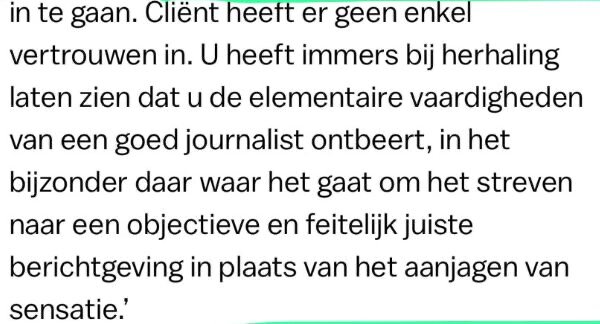
That's exactly what Marlon experienced in this case too. Not journalism aimed at uncovering the truth, but the gathering of incriminating stories from a political circle that had been looking for ammunition against him for years. After the first articles, VSP's opponents smelled blood. What began as a provoked bar-room scuffle was seized upon to finally achieve what reports, dossiers and university politics hadn't managed: damaging Marlon, Reinout and VSP through media, reputational harm and social pressure.
Tahrim Ramdjan sent messages to as many as a hundred people connected to the VU, asking whether they knew Marlon and whether they'd had negative experiences with him. It was emphasised that contact with sources would remain strictly confidential and that their identity would never be revealed. In theory, source protection is a journalistic principle. In this context, it worked differently. In an environment where the same activist circle had spent years trying to damage Marlon and VSP, anonymity became a weapon.
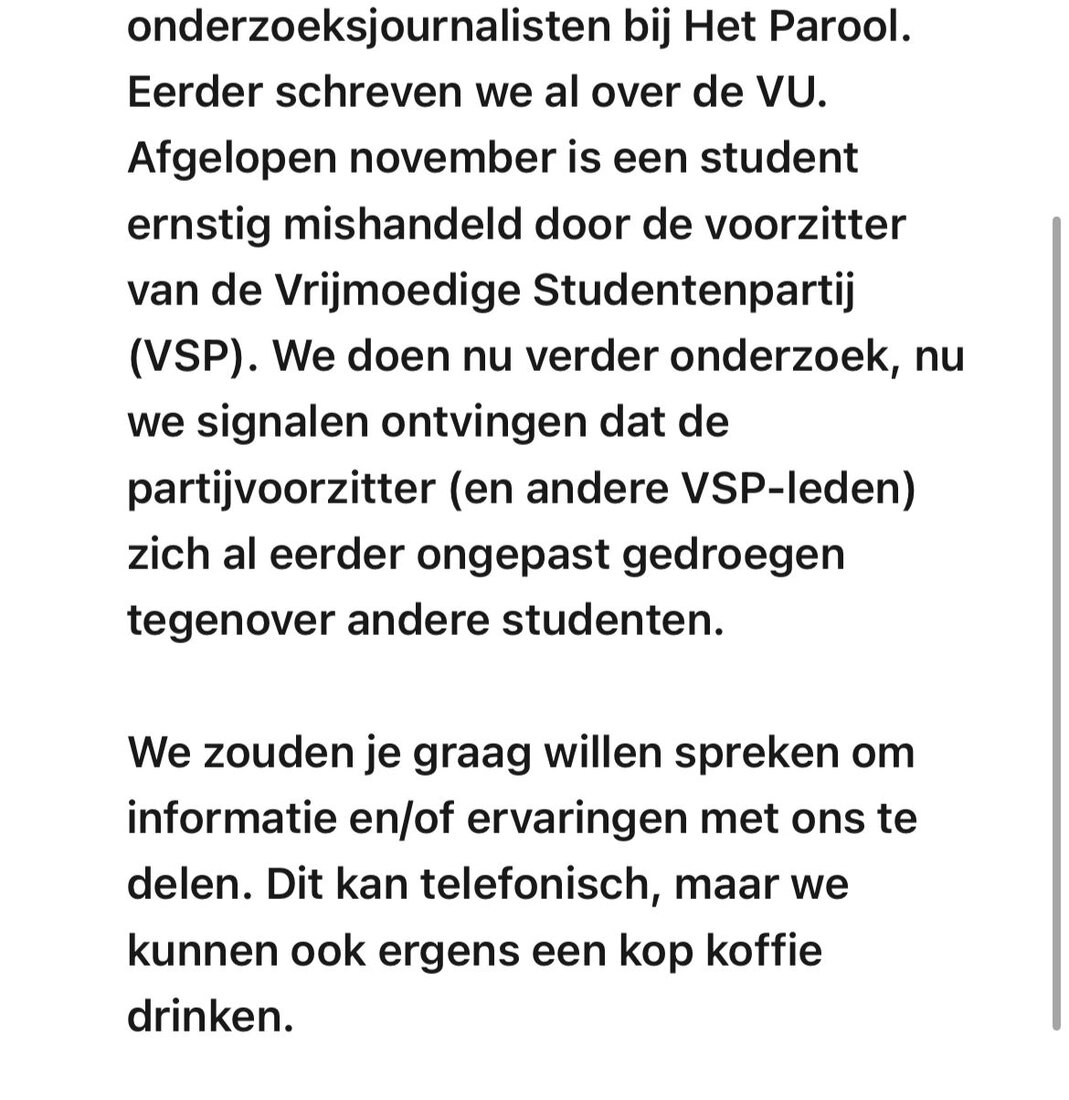
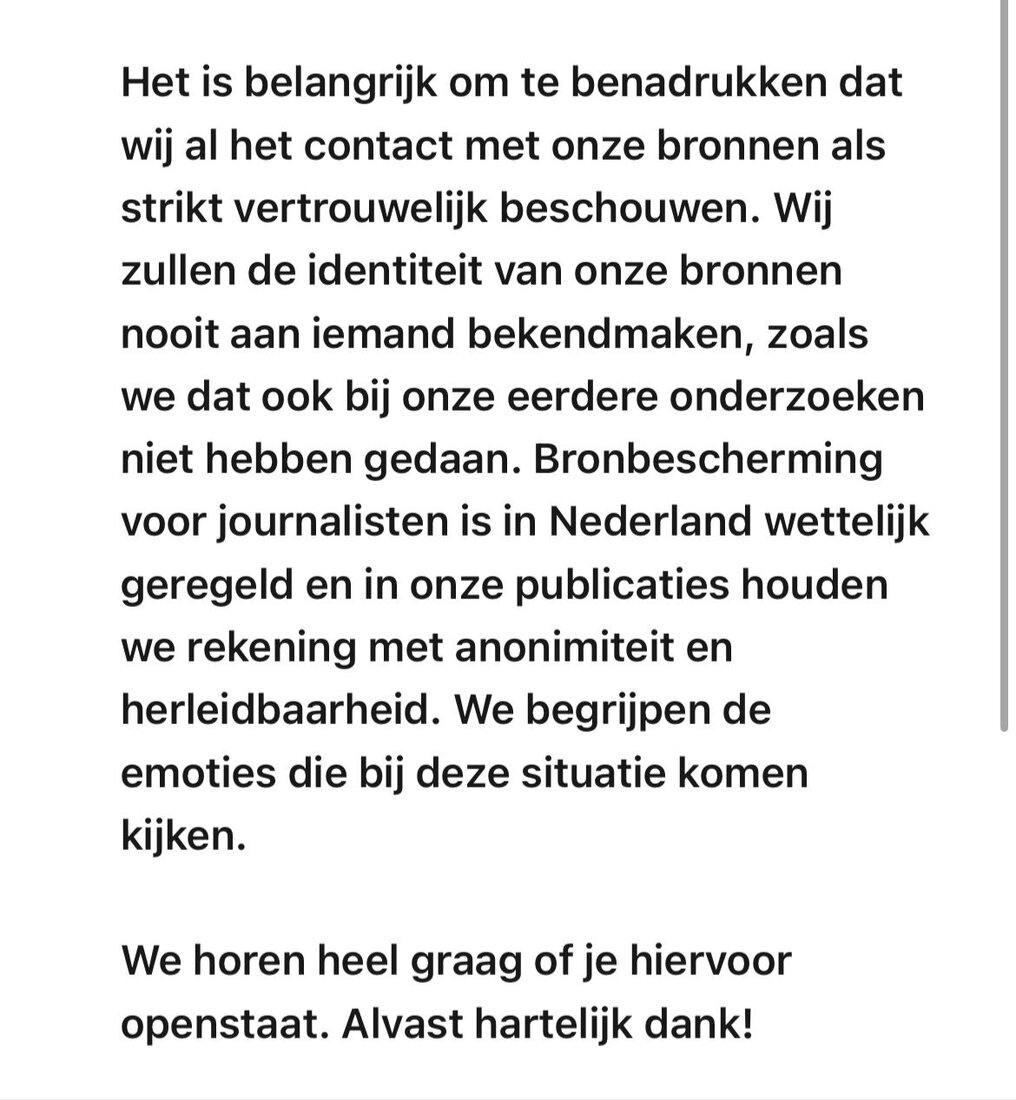
Anyone wanting to settle a political score could claim anything without visibly bearing any responsibility for the consequences. In the end, about thirty people responded, again from the same circle that keeps recurring throughout this record: ChangeVU, SRVU and VU for Palestine. The same circle as with earlier false reports, the same circle as with the dossiers, the same circle as with the witness statements around the incident.
The result was an email from Tahrim Ramdjan containing around fifty questions. The allegations weren't limited to Bar Boele, but covered everything that can socially destroy someone in today's cancel culture: sexually inappropriate conduct, assault, physical violence, threats, racism, homophobia, transphobia, Nazism and far-right associations. Every classic cancel-culture label made an appearance.
Some of the questions were so absurd that they said more about political opponents' willingness to destroy Marlon than about reality. One example:
According to those involved, you kissed a VU staff member on the mouth that evening, after shouting: "He faggot, faggot, can I get a kiss?" Do you recognise this, and how do you respond?
— from Tahrim Ramdjan's questionnaire (Het Parool)
You couldn't make it up.
On Marlon's behalf, a warning was given in advance that such accusations, without hard evidence, would have enormous consequences for his safety, reputation, studies, work and future. That wasn't a theoretical concern. Because of earlier publications, Marlon had already faced serious threats and was partly staying abroad. Tahrim Ramdjan pressed on regardless.
The article was published anyway. It was full of false insinuations, anonymous statements and distorted accounts. The damage was enormous. More threats followed, including death threats. Marlon lost his job. Important job applications were cut short: opportunities he had worked toward for three years. Everything he had built with time, energy and good intentions was torn down in an instant. VSP took a hard hit as less loyal members grew afraid for their own reputations. Reinout was dragged into the same media storm and risked falling behind in his studies. And all of this before a judge had even looked at the case.
The story was then picked up and spread further by other outlets. But Marlon and Reinout themselves weren't invited to calmly explain their side. People mostly talked about them, not with them. That gave the frame every opportunity to take hold before a judge had assessed the footage, or before the other side had genuinely been heard.
Later, this campaign went too far even for some within ChangeVU. The then-chair and vice-chair of the university council, who had been elected for ChangeVU, resigned. It then came out that people had "exaggerated or made things up, and left other things out" when speaking to the media, exactly the warning Marlon had given in advance.
But that nuance never made it into the major media. There was no honest correction. There was no broad rehabilitation. Het Parool kept publishing follow-ups, and the framing kept spreading further. In fact, Tahrim Ramdjan's quasi-investigative article was later even used as a source in the probation process, as if an article full of anonymous, politically coloured accusations could be a serious basis for assessing Marlon for radicalisation.
That's the common thread running through this entire story. First there were false reports at the VU. Then dossiers. Then anonymous statements in the media. Then witness statements to the police. Always the same circle. Always the same method. Always anonymous, distorted, or unverifiable. And always the same goal: damaging Marlon, Reinout and VSP.
Where have we seen that before? The reports
After the publications, an email exchange followed with Tahrim Ramdjan of Het Parool about a correction. Marlon pointed out that the articles contained demonstrable inaccuracies, that serious accusations had been published without objective verification, and that it had by then even been acknowledged, within the circle of political opponents itself, that things had been exaggerated, invented and omitted in dealings with the media.
One concrete example was the accusation about an alleged kiss forced on a VU staff member. That staff member himself told Marlon, after publication, that the account in Het Parool didn't match reality. Yet Het Parool stood by its publications.
Tahrim Ramdjan and Tjarda Kuyt wrote on behalf of Het Parool that they had photos, videos, WhatsApp messages, emails, police documents and confidential reports from students. But when Marlon asked which specific accusations those materials related to, and how those materials would demonstrate their accuracy, no verifiable substantiation followed. Het Parool claimed there was a sound basis, but refused to hand over the source material, citing source protection.
And there was that word again: reports.
Where have we seen that before?
Exactly. Chapter one already explained how VSP had earlier faced reports from that same political circle: reports presented as though they were objective, but in reality built from anonymous, unverifiable and politically coloured accusations. The independent mediator said, literally, that it was "in fact a list of unsubstantiated claims by a representative of Change VU."
The email exchange with Tahrim Ramdjan shows exactly how that circle worked. Whenever Marlon asked for concrete verification, Het Parool kept pointing to sources, reports and material that was never produced. Whenever demonstrable inaccuracies were raised, and the acknowledgement that political opponents had exaggerated or invented things, no correction followed. At most, later publications made it somewhat clearer that Marlon disputed the allegations.
But the damage was already done by then. The accusations were online. The reputational harm had been inflicted. The threats had begun. And the anonymous statements from the same political circle had once again been used as fuel for the frame.
The demonstration of 12 February
On 12 February, a demonstration was organised against VSP and Marlon. Once again, the same circles came together: people from the environment of ChangeVU, SRVU, VU for Palestine and other activist networks.
Signs reading "FCK VSP" were visible at the demonstration. Antifa symbols were present too. That's bitter: a demonstration claiming to be about social safety and against violence made room for the symbolism of a movement itself strongly associated with confrontation, intimidation and violence.
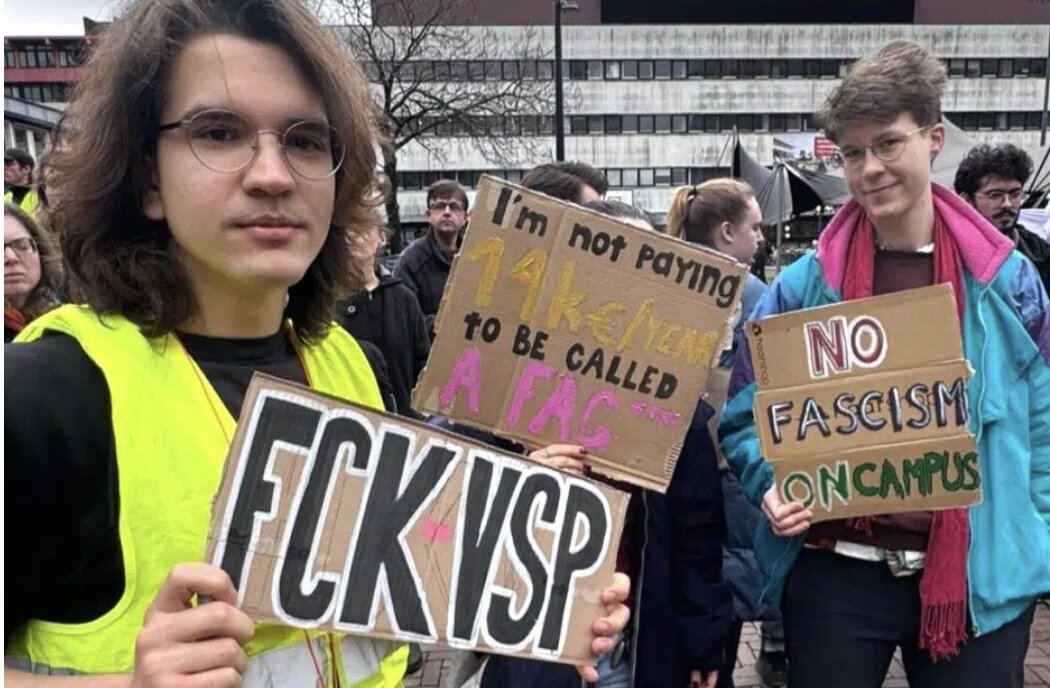
The irony grew even sharper because, that same week in France, a young man, Quentin, was killed following a violent confrontation with far-left Antifa demonstrators. That's not a central issue in this record, but it does show how selectively the concept of "social safety" was applied. The harshest moral language was reserved for VSP. At the same time, people were free to visibly associate themselves, at that same demonstration, with a movement itself linked to political intimidation, violence, and even killing.

The justice system presses on
After a brief period of relative calm, the next blow came.
Marlon had to learn through media coverage that the Public Prosecution Service would actually pursue the case. The suspicions were serious. Marlon was prosecuted for attempted serious assault, public violence and discrimination. Reinout was prosecuted for public violence and discrimination.
Het Parool made big news of it again. According to the coverage, Reinout faced up to six years in prison, and Marlon as much as just over seven.
Probation and the radicalisation frame
In preparation for the trial, Marlon received an invitation from the probation service. The Public Prosecution Service had requested an advisory report on him for the case.
What happened next shows just how far the frame had come by that point.
Marlon found himself dealing with officials who worked on radicalisation and extremism. Apparently, it had to be investigated whether he was a radicalised extremist, not based on proven facts, but based on the image that had by then been created of him.
The questions ran along these lines:
Do you believe, like Thierry Baudet, that we are ruled by reptiles?
Could you have a relationship with someone who isn't white, for example someone from Suriname or Nigeria?
What do you think of multicultural society?
Do you know Gideon van Meijeren?
Do you believe in paedophile networks?
— from the questions the probation service put to Marlon
There sat Marlon, apparently having to prove he wasn't a radical extremist.
Personal questions were also asked about his youth and background. And what served as an important basis for these concerns? Tahrim Ramdjan's quasi-investigative article for Het Parool, an article full of falsehoods, anonymous statements and distortions, was used as a guide for a conversation about radicalisation.
After two sessions, even the probation service had to admit this picture didn't hold up. There was no reason for supervision. No reason for interventions. No indication that Marlon was a radicalised extremist who, based on extreme convictions, would harm anyone.
The probation service's conclusion was clear:
We do not consider interventions or supervision necessary. There is, after all, a low risk of reoffending.
— conclusion of the probation report
That took them two sessions to work out.
The trial of 4 June
The trial took place on 4 June.
Not before a single judge, but before a full panel of three judges. With a large press presence. With friends and allies of the student involved in the courtroom. With an interpreter for the student involved. All of this for a provoked bar-room scuffle lasting about thirty seconds.
The hearing ultimately lasted about five hours.
Beforehand, the expectation was that as soon as the camera footage was shown, it would become clear that all the fuss surrounding this case had been disproportionate. That it wasn't serious assault. Not a hate crime. Not a joint attack by Marlon and Reinout. Not a case that justified months of media attention and a full panel of judges.
After about two and a half hours, the footage was shown in the courtroom. For many present, that was a strange moment. Because anyone watching the footage might well ask: is this really why we're here?
Was this worth a months-long media campaign?
Was this worth taking someone from their bed?
Was this worth a wiretap?
Was this worth a probation interview about radicalisation?
Does this really need a full panel of judges?
During the hearing, it also became clear what Tahrim Ramdjan's Het Parool publications had personally caused. When Marlon spoke about the serious consequences of those articles (the threats, the reputational damage, the fear, the job loss, the personal disruption), Tahrim Ramdjan himself sat in the courtroom. Rather than showing any restraint or awareness of the impact, he reportedly smirked several times, according to those present. Right at the moment his publications' consequences were being discussed, his demeanour carried every appearance of taking pleasure in it. That made the situation even more painful for Marlon, his family and his friends.
The prosecution's demand
After the questioning, in which Marlon and Reinout were again asked what they had and hadn't said, the Public Prosecution Service made its demand.
That demand landed like a bomb.
The prosecution began with an account of events that didn't match the camera footage. The attempted serious assault charge was justified on the idea that serious injury could have occurred. But watching the footage shows the opposite: if Marlon had genuinely intended to seriously injure someone, he could easily have done so at that moment. That didn't happen.
Reinout was accused of public violence because, according to the prosecution, he had enabled Marlon to commit violence and had pushed people away. But the footage, and his own actions, showed the opposite: that he didn't actively take part in the physical moment and tried to de-escalate the situation.
And then came the discrimination narrative.
That's where it became truly clear how far the frame had gone. The prosecution argued that the contradictory witness statements would nonetheless be sufficient to assume discriminatory words had been spoken. But even setting that aside, reasoning was used that lost all connection to evidence.
During sentencing, the prosecutor said that the fact that Marlon and Reinout are two "white" men, and the student involved is Egyptian, could in itself already be sufficient to describe the incident as discrimination. Not because the footage proved it. Not because there was audio. Not because there was objective evidence of a racist motive. But because the student involved might have experienced it that way.
Under that reasoning, "white" Dutch people must be extra aware of possible "risk of offence" when dealing with minorities, because certain words might be experienced as hurtful by minorities. That suddenly meant criminal law was no longer based on what was demonstrably said or done, but on identity, perceived feeling, and the assumed power relation between two "white" men and an Egyptian student.
That's precisely why this case became so dangerous. A provoked bar-room scuffle wasn't assessed on the footage, the injuries, the context and the facts, but on an ideological framework: white versus non-white, majority versus minority, offence versus evidence.
While the insults Marlon and Reinout themselves received that evening, "nazi", "fascist" and "fucking nazis", barely seemed to carry any weight, the alleged hurt feelings of the student involved were placed front and centre. Not what was proven, but what could be felt, was made decisive.
That shifted the core of the case entirely. It was no longer just about what had demonstrably happened. It was no longer about footage, injury and evidence. It suddenly became about interpretation, identity and feeling. And on that reasoning, the prosecution tried to turn a brief, provoked scuffle into a discrimination case after all.
Six months and five months in prison
The demand was disproportionate.
Against Marlon, the prosecution demanded six months in prison, three of them suspended. Against Reinout, five months were demanded, also with three suspended.
The courtroom was shocked. Family and friends of Marlon and Reinout were visibly emotional. Afterward, those present said out loud what many were thinking: what an injustice.
And the student involved and his allies? They found it necessary to mock and provoke the emotional family all over again.
Two weeks later, the court's ruling would follow.